Expert Achilles tendon care in Prahran
Achilles Tendinopathy Treatment in Prahran, Melbourne
Achilles tendon pain can make walking, running and sport difficult. With an accurate assessment and a well-structured treatment plan, you can build strength, improve comfort and work confidently towards the activities you enjoy.
Our registered podiatrists assess both midportion and insertional Achilles tendinopathy and begin practical management at your first appointment.
Your treatment plan brings together the approaches most appropriate for you, including progressive tendon-loading exercise, radial shockwave therapy, foot orthoses, taping, heel lifts, footwear advice and activity management.
Understanding the condition
What is Achilles tendinopathy?
Achilles tendinopathy occurs when the tendon becomes painful and less able to tolerate the loads placed on it. It is a common cause of pain behind the heel and can develop after a change in activity, training, footwear or recovery.


Pain through the tendon
Pain and stiffness are felt through the middle of the tendon, usually more than 2 cm above its attachment to the heel. The tendon may feel tender or thickened and can become painful with running, hills, jumping or calf raises.
Pain at the heel attachment
Symptoms are felt where the tendon attaches to the heel bone. Shoes, uphill walking and exercises that compress the tendon against the heel can aggravate the area.
Morning stiffness
Stiffness or discomfort is often noticeable with the first steps after rest and may ease as the tendon warms up.
Activity-related pain
Walking, running, jumping, hills or prolonged time on your feet can increase symptoms during or after activity.
Reduced strength or confidence
Calf raises, pushing off and returning to sport may feel weaker, uncomfortable or less reliable than usual.
Your first consultation
How we assess Achilles tendon pain
An accurate diagnosis allows your podiatrist to explain the problem clearly and build a treatment plan around your symptoms, activities, footwear and goals.
Listen and understand
Your podiatrist will discuss when the pain began, where it is felt, changes in activity or training, previous injuries and the treatments you have already tried.
Examine and assess
We assess the location of pain, tendon tenderness, ankle movement, calf strength, load tolerance, walking pattern and footwear.
Explain and begin care
Your podiatrist will explain the likely diagnosis and begin practical advice and treatment at your first appointment.
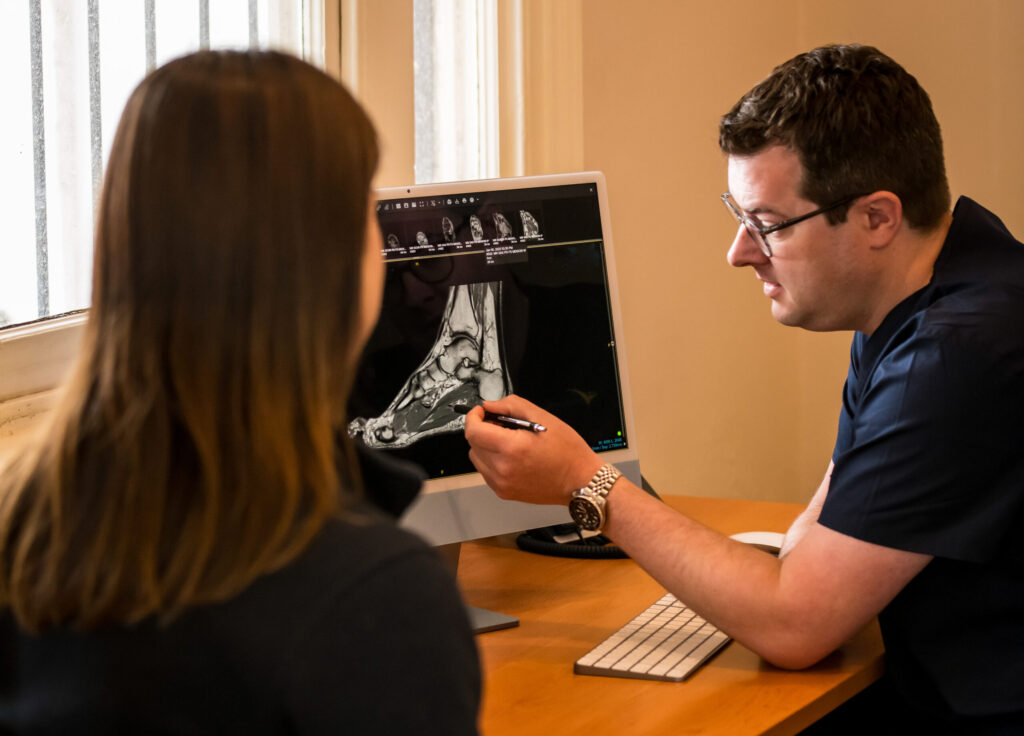
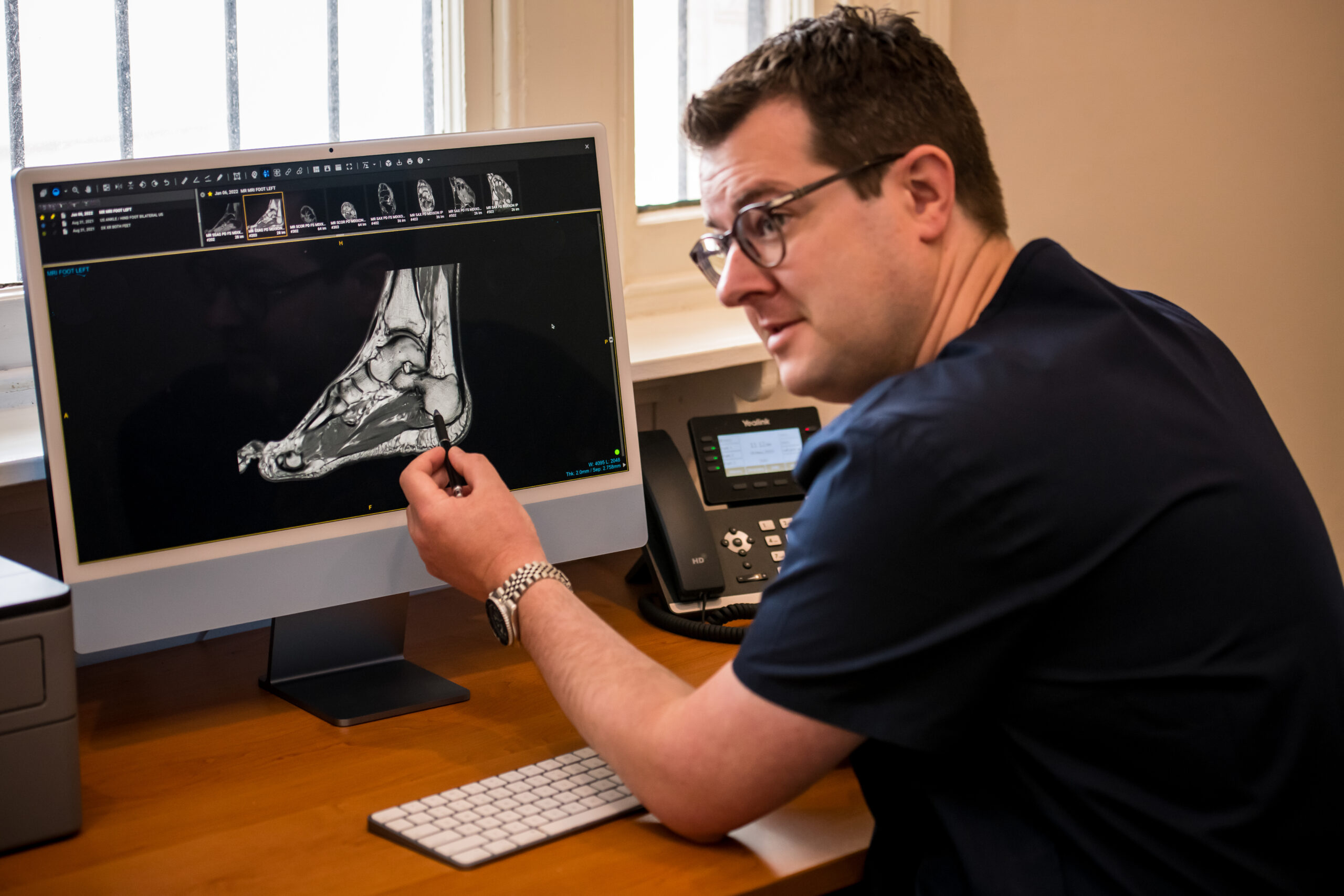
Will I need an X-ray, ultrasound or MRI?
Many presentations can be diagnosed through a careful clinical assessment. When X-ray, diagnostic ultrasound or MRI is required to confirm the diagnosis, assess the tendon or exclude another injury, the appropriate investigation will be arranged by your podiatrist.
A plan built around you
Achilles tendinopathy treatment
Treatment is tailored to the type of Achilles tendinopathy, how long it has been present, your current capacity and what you need to return to. Your plan can combine the following approaches.
Progressive tendon loading
A structured exercise program forms an important part of the overall treatment plan. Exercises are progressed to rebuild calf and tendon capacity for walking, running, work or sport.
Radial shockwave therapy
Shockwave therapy is an established treatment option for Achilles tendinopathy and can be combined with progressive rehabilitation to reduce pain and improve function, particularly when symptoms have persisted.
Foot orthoses and insoles
Prefabricated insoles or custom foot orthoses can improve comfort and load distribution when foot mechanics, footwear or activity demands are contributing to symptoms.
Activity and load management
We help you adjust aggravating activity without unnecessarily stopping movement, then build a practical progression back towards normal activity.
Taping, heel lifts and footwear
Taping, temporary heel lifts and footwear recommendations can reduce aggravating strain and improve comfort while tendon capacity is rebuilt.
Additional treatment and referral
Where appropriate, your podiatrist can discuss other treatment options, arrange diagnostic imaging or coordinate referral for another medical opinion.
Confident care with regular review
Achilles tendinopathy responds well to consistent, progressive management. Your podiatrist will monitor pain, morning stiffness, strength and activity tolerance, then adjust the plan as your capacity improves.
Returning to activity
Recovery is built progressively
Recovery time varies, but a clear plan removes guesswork. We help you understand what level of activity is appropriate, how to progress exercise and what signs indicate that the tendon is tolerating more.
Settle aggravating symptoms
Early changes reduce unnecessary irritation while maintaining an appropriate level of movement and activity.
Build strength and capacity
Exercise and supporting treatments are progressed according to your response rather than following a rigid one-size-fits-all timetable.
Return with confidence
Walking, running, work or sport is reintroduced progressively so the tendon is prepared for the demands that matter to you.
Helpful answers
Frequently asked questions about Achilles tendinopathy
Is Achilles tendinopathy the same as Achilles tendonitis?
The terms are often used interchangeably. Achilles tendinopathy is the preferred term because persistent tendon pain involves changes in tendon structure and load tolerance rather than simply short-term inflammation.
Can treatment begin at my first appointment?
Yes. Following your assessment, your podiatrist will explain the likely diagnosis and begin practical management. This may include activity guidance, footwear changes, taping, heel lifts or an initial exercise plan.
Will I need an X-ray, ultrasound or MRI?
Not every case requires imaging. When X-ray, diagnostic ultrasound or MRI is required to confirm the diagnosis, assess the tendon or investigate another possible injury, it will be arranged by your podiatrist.
Can I continue walking, running or exercising?
Complete rest is not usually the goal. Activity is adjusted to a level the tendon can tolerate, then progressed as pain, strength and function improve. Your podiatrist will provide clear guidance for your situation.
Can shockwave therapy help Achilles tendinopathy?
Yes. Radial shockwave therapy can reduce pain and improve function as part of a broader treatment plan, particularly when symptoms have persisted. It is commonly combined with progressive tendon-loading exercise and other measures identified during assessment.
Will I need foot orthoses?
Foot orthoses are an important treatment option when foot mechanics, footwear or activity demands are increasing stress on the tendon. Your podiatrist will explain whether a prefabricated insole or custom foot orthotic is appropriate.
How long does recovery take?
Recovery varies according to the type and duration of the condition, tendon capacity and activity demands. Many people notice meaningful improvement as treatment progresses, while rebuilding capacity for running or sport can take longer.
Clinical references
- Achilles Pain, Stiffness, and Muscle Power Deficits: Midportion Achilles Tendinopathy Revision 2024
- Diagnostic Imaging for Achilles Tendinopathy: A Nuanced View
- Extracorporeal Shockwave Therapy for Midportion and Insertional Achilles Tendinopathy: Systematic Review
Clinically reviewed by Prahran Foot Clinic’s registered podiatrists. Updated August 2026.
Consult with Our
Experienced Podiatrists
Our experienced podiatrists provide personalised, evidence-based care for foot and ankle conditions.

Get in touch
Have a question or need help arranging an appointment?
Contact our friendly team and we’ll respond as soon as possible.
Ready to book? Use our online booking system.
Opening Hours
Mon–Fri: 10 am–7 pm
Sat: 9 am–1 pm